
Posts

May 24, 2021

Image
  11:24 AM 5/24/2021 Instead of finishing my CS homework I decided to write some more about my thoughts for the time being.  Many people associate their identities with the subject of their passion, people they adore, and beliefs they adhere to. These are first and foremost relevant foundations of our consciousness, and therefore extremely important to us, that is, in our awakening hours here. However, a mere attachment to these ideas distort the sense of existence in another way. This attachment to other worldly, learned concepts does not establish the self. For the self to be born, one must create and branch off from pillars of our known realm. Growth by any other means would be following a cyclic behavior, intending to meet oneself but never reaching the path you walk down on. What purpose is there to livelihood, if not to absorb and contain the world at once? To be content with the quietude at night just as the quietude of the soul. What is there to lament, if all that is ...
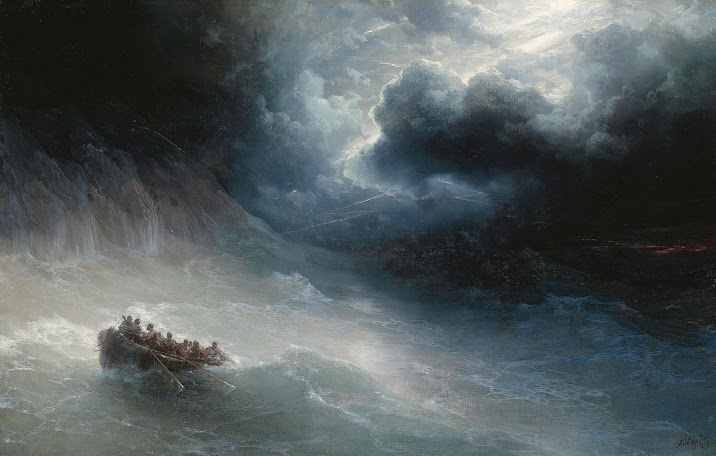
On the Sea

Image
Ivan Konstantinovich Aivazovsky - The Wrath of the Seas Beyond the alcoves bend lays wrested faiths muffled despair coupled with songs of siren here you sail without a trace Though tempests and torrents torment  by nightfall they are forgiven whence the grandeur of metropolis rise  if not upon shoulders of tamed men? for their benevolence is shallow in the sea steel and bones erodes your amorphous Aphrodite she  will emerge from these riptides you shall never anchor foam past mortal eyes she glides incense, rosary, and intercessions until your turmoils subside myths of men lost in the blue  deterioate and demise

Cassiopeia

Image
Ballads and hymns alike  fawn for forlorn Cassiopeia  with mirth and visions plenty, she  bows to nameless anthems sung. Men clouded with their omens yearned for daybreak too late   sapphires, chalcedony, and amethyst changed their dispositions and fate. This sweet empire on the cliffs  chants Alcaeus to day's end flowing streams of belief  until centuries relent.

Literary Analysis: Locke's Second Treatise on Government

Image
             John Locke’s second treatise on government aims to demonstrate the fundamental idea of independence. John Locke’s Second Treatise on Government illustrates the essential importance of rhetoric and language in works of persuasive non-fiction. Locke presents an argument in defense of democratic government, led by the majority. He relies upon a number of different rhetorical tools in his discussion, including ethos or authority, comparison, figurative language, and analogy. While the lasting political influence of Locke’s writing is undeniable, his rhetorical skill contributed to his importance and historical relevance.  Locke uses upon both his own authority and divine authority in this text from the late 17th century. As a philosopher, he was a learned man and could produce a thoughtful and logical argument, but as a man in a religious era, divine authority proved even more critical to his discussion. Divine authority, including...

Literary Analysis: Camus' The Plague

Image
 Written in 2017, but happened in 2020: The Plague Bibliographic Information:  Camus, Albert. The plague . 1947. Translation by Stuart Gilbert. Literary Era: Along with The Stranger , The Plague belongs to the literary era of existentialism (1850-present).  The Plague , originally published in 1947, illustrates a multitude of sociological and philosophical aspects concurrent with the historical era. Albert Camus, the author of The Plague , was born on November 7, 1913, in the district of the colonized French Algeria. Recognised as Camus’s second grand work, The Plague trailed after The Stranger as the eminent pronunciation of life as Camus sees it. The influence of Camus’s philosophical being had its toll on his perspective, as he embraced and supported the school of thought known as absurdism around the 1930s. His novel revolves around the study of absurdism and mild nihilism, by which he creates a society to enact the two concepts with. Often echoing the voice of the...

Summary of Diamond's Guns, Germs, and Steel

Image
Written in 2017 Guns, Germs, and Steel Prologue: Yali’s Question Such as the aboriginal inhabitants of Australia, the Americas, and southernmost Africa, are no longer even masters of their own lands but have been decimated, subjugated, and in some cases even exterminated by European colonists. (15) Why did wealth and power become distributed as they now are, rather than some other way? Technological and political differences as of AD 1500 were the immediate cause of the modern world’s inequalities. But how did it get to this way? Why did human development proceed at such different rates on different continents? Those disparate rates constitute history’s broadest pattern and this book’s subject. Yali’s question: Why is it that you white people developed so much cargo and brought it to New Guinea, but we black people had little cargo of our own? (14) Counter Arguments (17) :  1. If succeeded in explaining how some people came to dominate other people, may this not seem to justify the...